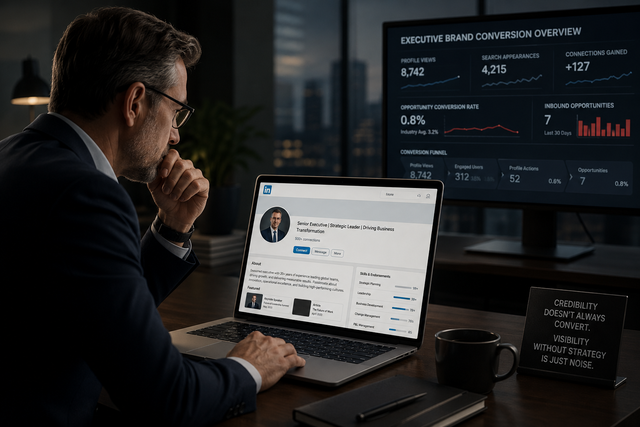

 Here’s something nobody tells you about building in public: it doesn’t necessarily get easier as you become more successful. For a lot of leaders, it gets harder.
You’d think the opposite would be true. More experience, more wins, more proof. Surely, at some point, the fear just switches off. But that’s not what I see. The professionals I work with are typically between the ages of 40 and 65, seasoned and accomplished. Yet many of them hesitate when it comes to “putting themselves out there.” Despite decades of career success, they hold back.
And honestly, I get it. I’ve felt it too. Last week I wrote about what’s happening in your head in the thirty seconds before you hit post. This week, I want to talk about the bigger pattern behind it, the one I named in Chapter 2 of Theatre of the Mind: the Visibility Ceiling.
Fear Doesn’t Fade With Success. It Evolves.
The higher you rise, the more visible you become. And visibility creates its own kind of pressure: the weight of perception. It’s not just about making the right call for your business. It’s about doing it in front of peers, competitors, and stakeholders who are watching closely.
That’s why I call it the Visibility Ceiling. It’s not technical skill that holds most leaders back. It’s fear: of scrutiny, of missteps, of being “found out.”
The truth is that fear doesn’t always fade with success. In fact, it can intensify. The more there is to lose, the louder the internal dialogue becomes, unless it’s intentionally re-scripted.
When you’re early in your career, a clumsy post is just a clumsy post. When you’re a CEO, a founder raising capital, or an executive with a board and a team watching, every word feels like it carries your livelihood. So the stakes in your head go up, even if the actual risk of sharing a thoughtful perspective hasn’t changed at all.
The Outdated Mindset That Keeps Senior Leaders Quiet
Part of what makes the ceiling so sticky for experienced leaders is an outdated belief that runs deep in Corporate America: you are not the brand, the company is.
If you came up in that culture, building in public can feel almost like breaking a rule. Your instinct is to let the logo do the talking, to hand visibility to marketing, to wait for a specific reason or the perfect moment to start. I see it all the time. Many clients admit they’d been thinking about working with us for years before finally booking the call. So what’s the holdup? Almost always, it comes down to fear of failure.
That fear has a name, atychiphobia, which the Cleveland Clinic defines as an intense fear of failure.2 It can cause someone to procrastinate or avoid any situation with the risk of an unsuccessful outcome. In a building-in-public context, it looks like the post that never leaves drafts and the strategy that’s always “next quarter.”
But waiting for the perfect moment often leads to misaligned expectations, missed opportunities, and deeper frustration. Action is the only antidote to anxiety.
Imposter Syndrome Shows Up After You’ve Already Won
If fear of failure stops you before you act, imposter syndrome gets you after. It’s the internal voice that says You’re not good enough, even when the results say otherwise.
The term was first introduced in 1978 by researchers Pauline Rose Clance and Suzanne Ament Imes, who studied 150 high-achieving women, including PhD holders and respected professionals, who despite external validation felt they had somehow deceived others into thinking they were more competent than they were.3,4 Sound familiar?
For leaders building in public, imposter syndrome causes hesitation, overthinking, and a tendency to play it safe. It can lead to avoiding visibility altogether, and even to envy when you watch others confidently promote themselves.
I’ll be honest: before writing the book, I didn’t believe imposter syndrome was a real thing. Then, in 2025, years after I started this work, I hit a wall. This time the stakes felt higher. I had more to lose. Stress, grief, and pressure around my book, my business, and my content all collided, and I found myself back in the loop:
- What will they think?
- What if I fail?
- Why does all my content sound like everyone else’s?
- Who am I to publish this?
This thinking is common when you’re building anything in public. My online audience has grown to over 200,000 people, and that number can feel heavy, not because I’m chasing it, but because I know someone is watching and learning. It’s a privilege. It’s also a pressure I’ve had to learn how to hold. Success didn’t remove the fear. It just changed its costume.
Know the Loop So You Can Break It
When visibility spikes, your brain interprets it as a threat. Your amygdala doesn’t distinguish between standing in front of investors and standing in front of a predator. It defaults to fight, flight, or freeze.5 That’s what creates what I call the Theatre Loop:
- Perception of risk (What will they think?)
- Physiological response (Heart racing, shallow breathing)
- Mental rehearsal of worst-case scenarios (Judgment, failure, shame)
- Avoidance or overediting (Freezing, refining, procrastinating)
- Confirmation (Silence = safety. So, we repeat the cycle.)
This loop is not a personal failing. It’s your brain doing its job. But if you’re not aware of it, it takes over. Awareness is the break in the cycle. Call it out, and you regain control.
One of the best tools I’ve found for breaking it comes from Rebecca Fitzsimmons, a Borden Group client who spent nearly 15 years as a Special Agent with NCIS before becoming a leadership coach. As she prepared to launch her book, Unleashed, she faced the visibility she once feared, and her presence grew sharper. She teaches what she calls a Mindset Reset, and it translates beautifully to building in public:
- Notice the familiar. When you catch yourself avoiding a post, say out loud: “This is my brain resisting the unfamiliar.”
- Redirect your strongest thoughts. “Your body doesn’t know the difference between a real event and an imagined one,” Rebecca says. Spend five minutes visualizing your post landing well instead of rehearsing the worst case.
- Train resilience daily. Pick one small daily discipline, like finishing a post or newsletter draft. Keeping the promise matters more than the size of it.
- Reframe fear. “Another level, another devil,” as Rebecca puts it. When fear hits, ask: “If this fear is proof I’m growing, what’s the next step?” Then take it before hesitation takes over.
The Proof’s in the Binders
Knowing the loop helped me. But what actually pulled me out, both in 2019 and again in 2025, was something much simpler: evidence.
I’ve kept two massive binders of “wins” since 2002. Yes, binders, with real, printed paper. Handwritten cards from old bosses, performance reviews, printed emails, revenue reports, awards, speaking gigs, LinkedIn comments, press features, even newspaper clippings. These binders don’t lie. They remind me who I actually am, not who anxiety says I am.
When imposter syndrome whispered, They’re going to figure out you don’t know what you’re doing, I asked myself three questions. And here’s what I want you to notice: those same three questions are also the best content strategy I know for building in public.
Turn Your Binder Into Your Content Map
Set aside thirty minutes this week and work through these. Write your answers down. Then look at them as a list of things you’ve earned the right to talk about.
- What have you achieved?
Get specific: the tangible wins, results, campaigns, launches, and turnarounds. These are receipts, not fantasies. For building in public, each one is a story. Not a brag, but a lesson: what you were facing, what you decided, and what you’d tell someone in the same seat today. A post might sound like: “Ten years ago I led a turnaround I was sure would fail. Here are the three decisions that actually mattered.”
- What have people said about your work?
Call your people, the clients, colleagues, mentors, and friends who know your magic. A five-minute conversation can redirect your entire mindset. Then listen for the language. The words other people use to describe your value are often clearer than the words you’d choose yourself, and they make strong anchors for what you share.
- What do people consistently trust you with?
Go back to testimonials, thank-you notes, email threads, and screenshots. When people keep saying the same thing about you, it’s not luck. It’s truth. This is the most important question for building in public, because the answer is your lane. Whatever people already trust you with is what you should be visibly building around.
Once you’ve gathered the evidence, do one more thing from the book: say your fear out loud. “I’m afraid I’m not as good as people think I am.” Then respond with the facts: “I’ve put in the work. I’ve delivered. I have achieved XYZ. This fear doesn’t get to decide who I am or where I’m going.”
Influence Is Built Above the Ceiling, Not in One Moment
One last thing that tends to keep senior leaders stuck: the belief that if they’re going to be visible, it has to be big. But virality and influence are not the same thing. One can be accidental; the other must be built. True influence takes time, repetition, depth, and trust.
Leaders who wait until they “feel ready” never step forward. Clarity comes from movement, not waiting. Every post compounds.
So, Here’s the GIST (Growth/Impact/Strategy/Trust):
- The Visibility Ceiling is fear, not skill.
The more successful you are, the more you feel you have to lose. That’s normal. Your job isn’t to eliminate fear, it’s to keep moving in spite of it.
- Name the loop to break it.
Risk, physical response, worst-case rehearsal, overediting, silence. Use a Mindset Reset to interrupt it in real time.
- Your evidence is your content.
What you’ve achieved, what people say about you, and what they trust you with: answer those three questions and you’ll never run out of things worth sharing.
- Build influence, not moments.
Consistency, depth, and repetition build trust. One viral post won’t break the ceiling. Steady visibility will.
I didn’t break through my own ceiling by waiting until the fear disappeared. I broke through by reminding myself, with real paper and real proof, who I already was, and then showing up anyway. Visibility has a price. But if you summon the courage to go for it, you can break through that ceiling and move into the success that lies beyond.
Contact Us if you would like to learn more about how we can help you or your business.
Don’t forget to follow Melanie Borden and The Borden Group on LinkedIn™ for more on all things personal brand strategy.
Sources
[1] Borden, Melanie. Theatre of the Mind. House of Lola, LLC, 2025. Chapter 2, “The Visibility Ceiling.”
[2] “Fear of Failure (Atychiphobia): Causes & Treatment.” Cleveland Clinic, September 12, 2025. https://my.clevelandclinic.org/health/diseases/22555-atychiphobia-fear-of-failure
[3] Clance, Pauline Rose, and Suzanne Ament Imes. “The Imposter Phenomenon in High Achieving Women: Dynamics and Therapeutic Intervention.” Psychotherapy: Theory, Research & Practice 15, no. 3 (1978): 241–247.
[4] “You’re Not a Fraud—It’s Impostor Syndrome.” McLean Hospital. https://www.mcleanhospital.org/essential/impostor-syndrome
[5] Buades-Rotger, Macià, Frederike Beyer, and Ulrike M. Krämer. “Avoidant Responses to Interpersonal Provocation Are Associated with Increased Amygdala and Decreased Mentalizing Network Activity.” eNeuro 4, no. 3 (2017). https://www.eneuro.org/content/4/3/ENEURO.0337-16.2017