
I once had a client tell me on a discovery call that they hadn’t posted on LinkedIn, gone on podcasts, or written any thought leadership because they were worried about what potential investors would think. They didn’t want to risk it. At the time, I understood the fear completely, but I also assumed I was past it. Wouldn’t you know that after spending the last several months refining my pitch deck and building Dirty Hippie, I started experiencing the exact same thing.
This is coming from someone who has spent years helping executives and founders become more visible, built an entire business around personal brand and executive visibility, and literally wrote a book about what happens when we decide to be seen. I fully understand the benefits of building in public, and I still found myself wondering what a potential investor might think about something I posted. Would talking openly about building the company make me look inexperienced? Would someone think I was more interested in being seen than doing the work? Should I wait until I had more traction, a more polished product, or more proof before talking about it?
I knew better, but I still felt it. And that’s the part of building in public we don’t talk about enough. The stakes change as you become more visible, and sometimes the fear changes with them.
Visibility and the Weight of Perception
The higher the stakes, the easier it becomes to overthink being seen. You draft the article, read it four times, edit it again, schedule it, move it back, and maybe never publish it at all. It’s not necessarily because you don’t know what to say. It’s because you’re thinking about everyone who might eventually read it: your peers, employees, competitors, clients, board members, or, in my case right now, investors.
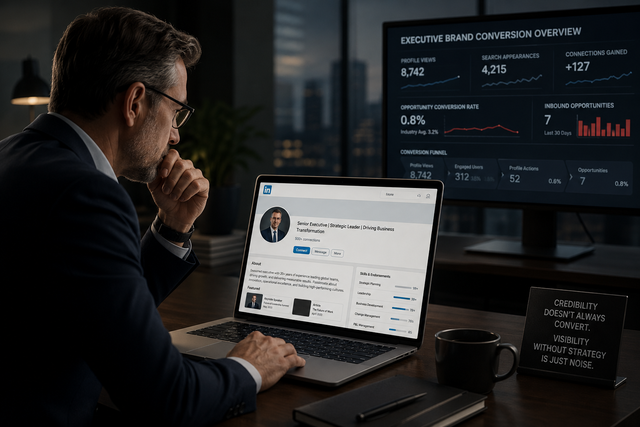
I call this The Visibility Ceiling. At a certain point, technical skill isn’t what keeps many leaders from becoming more visible. It’s the perceived risk that comes with greater exposure: scrutiny, judgment, making a mistake, or being “found out.” Building real influence requires vulnerability because you’re attaching your name to an idea before you know exactly how everyone will respond. You aren’t simply publishing content. You’re allowing yourself and your thinking to be perceived.
In Theatre of the Mind, I write about a pattern I call The Theatre Loop. It begins with the perception of risk: What are they going to think? That creates discomfort, which leads us to mentally rehearse everything that could go wrong. We overedit, procrastinate, refine, or avoid the thing altogether. When we don’t act, we experience relief. Silence feels safe, so the next time we’re faced with the same situation, we repeat the cycle.
I’ve watched executives who can comfortably speak in front of hundreds or thousands of people freeze when it comes time to publish two paragraphs under their own name. I’ve experienced it myself. It doesn’t necessarily mean you lack confidence or expertise. Sometimes it simply means you’ve reached a new level where being seen feels different. The problem is that if you continually respond to that discomfort by becoming less visible, you reinforce the very thing keeping you stuck.
Why I Don’t Believe Founders Should Wait for Permission
Founders are often told some version of this advice: stay quiet until you have traction. Build first. Talk later. Get the numbers. Prove the concept. Then tell everyone what you’ve been doing. I understand the logic, especially when the alternative is performing entrepreneurship instead of actually building a company. But I don’t believe traction exists only as a number on a pitch deck.
Traction can also be whether the right people already know your name before you need something from them. Your personal brand becomes professional equity you build before the ask. When you eventually need capital, talent, partnerships, customers, press, distribution, or introductions, you’re not introducing yourself and your thinking to the market for the first time. There is already context around who you are, what you believe, what you’re building, and why you’re the person building it.
This is why I’ve always viewed personal brand as much more than a marketing tool. For founders and executives, it can become a leadership and business asset. Building in public is one way of creating that asset because it allows people to understand the work before you need them to participate in it. You don’t have to share everything. You don’t have to publish every number, every meeting, or every problem. But waiting until everything is finished means you begin building attention at the exact moment you need to use it.
Taking My Own Advice
Earlier this summer, I had a post drafted about the origin of Dirty Hippie. I almost didn’t publish it. I kept imagining a potential investor finding it later and deciding I looked inexperienced or that I was spending too much time talking about building instead of actually building. Eventually, I recognized exactly what I was doing: I was hitting my own Visibility Ceiling.
So I published it anyway, and then I kept going. I started sharing more about Dirty Hippie, what I was building, what I was learning, and what it feels like to enter an industry I haven’t spent my entire career in. The response genuinely surprised me. People started reaching out asking when Dirty Hippie was coming to their market, how they could become involved, and whether there were opportunities to partner. It wasn’t a KPI sitting neatly on a dashboard, but it was a signal that people understood the problem and wanted to know more about the solution.
I also sent my pitch deck to the incubator before I thought it was perfect. I agreed to pitch Dirty Hippie at our graduation in New York while I was still figuring out parts of the business. I won best pitch. None of those things felt particularly brave while I was doing them. They felt like exposure. I didn’t suddenly feel ready. I felt like a first-time tech founder who was learning as she went because that’s exactly what I was, and still am.
That’s an important distinction. Courage rarely feels like courage while you’re doing it. Sometimes it feels like hitting publish while your stomach drops. Sometimes it’s sending the deck before you’ve answered every possible question. Sometimes it’s walking into a local business and explaining the marketplace you’re building before all of the technology is in place. The action comes first, and your confidence catches up later.
Courage > Permission
This is what I keep coming back to: Courage > Permission. Building in public isn’t about waiting for perfect timing, approval, or a guaranteed outcome. If you require those things before you move, you can spend a very long time waiting. Confidence doesn’t always arrive before the action. In my experience, much of the confidence comes because of the action.
That matters even more during periods of reinvention. If you’re building something new, changing industries, raising capital, launching a company, or stepping into a bigger leadership role, people need enough context to understand where you’re going. Visibility gives them that context. It allows people to watch your thinking evolve, understand what you’re building, and begin associating you with the problem you’re trying to solve before you ever need to make an ask.
This is why I believe reinvention requires visibility. Not because every part of your journey belongs online, and certainly not because every founder needs to become an influencer. It’s because doing meaningful work and making that work discoverable are no longer entirely separate things. You can quietly build until everything feels perfect, or you can allow the right people to see enough of the process that they understand what you’re building and why it matters.
I’m choosing the latter, even when it makes me uncomfortable. Because after years of advising other people on visibility and now having to apply the same lessons to myself in an entirely new arena, I’ve realized something: you don’t become ready and then become visible. Sometimes becoming visible is part of how you become ready.